
St Athanasius Church, Liverpool
A distinctive 1960s church with a large open-plan interior and high geometric ceiling installed wall-mounted infrared heaters to provide responsive heating for services and community events.
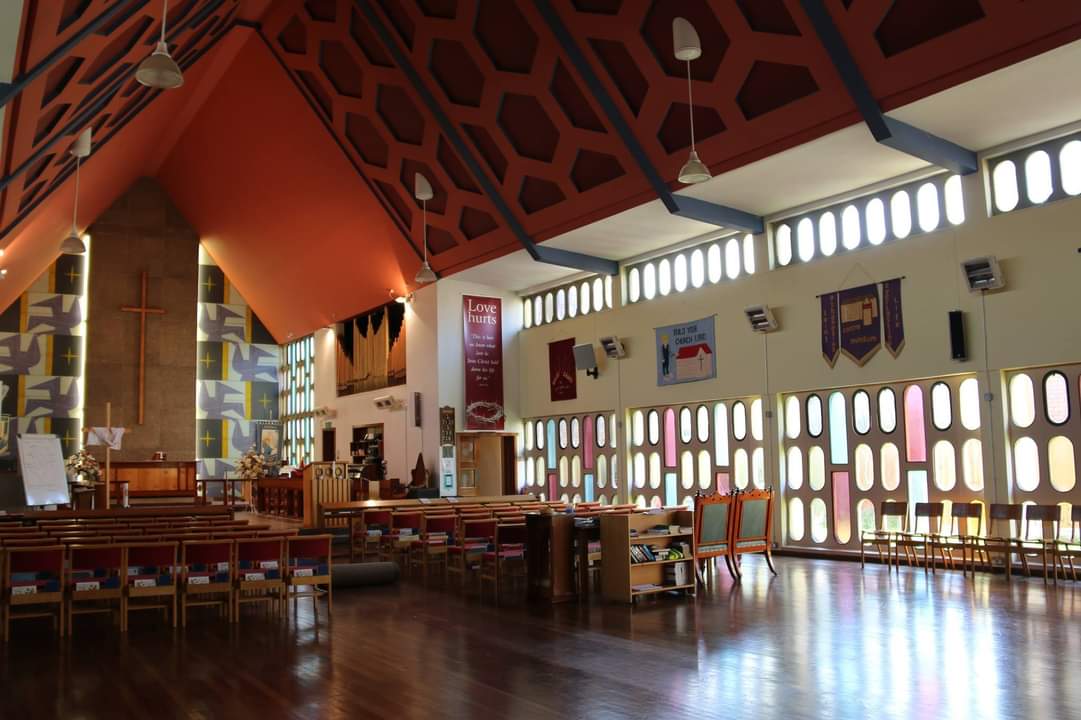
- Building
- Built 1956-57, modernist brick with geometric ceiling
- Diocese
- Liverpool (RC Archdiocese)
- Previous system
- Ageing convection heating
- New system
- Wall-mounted infrared radiant heaters
St Athanasius is a striking post-war church on Fountains Road in Kirkdale, Liverpool, built in 1956-57 to replace the original church destroyed in 1941. The modernist brick building has a distinctive geometric honeycomb ceiling, large coloured glass windows and an open-plan layout used for both worship and community gatherings. Chairs rather than fixed pews allow the space to be reconfigured for different events.
The challenge
The high ceiling and large glazed areas made the building expensive to heat with its existing convection system. Heat rose to the ceiling, leaving the occupied level cold. The open-plan layout meant the entire space had to be heated even when only part of it was in use, and the system needed long pre-heating periods before events.
The approach
Wall-mounted infrared radiant heaters were installed around the nave, positioned high on the walls and angled downward to cover the seating areas. Because infrared heats people and surfaces directly, the system works effectively despite the large air volume and high ceiling.
The church's flexible layout was a consideration in positioning the heaters. Coverage was designed so that warmth reaches the main seating configurations without needing to heat unused areas of the building.
Installation
The heaters were fixed to the existing walls with cabling routed along the wall surfaces. The 1960s construction made fixing straightforward compared to working with historic masonry. Installation was completed quickly with minimal disruption.
Result
The church now has heating that responds in minutes rather than hours. Services and community events can be heated on demand, and the building no longer wastes energy pre-heating a large volume of air. The open, flexible interior works as well heated as it does at room layout level.
Learn more about infrared radiant heating
Warms people and surfaces directly rather than heating the whole air volume, which suits tall, draughty church buildings that were never designed to be heated.
Want to talk through your options?
Tell us about your building and we will suggest the heating that suits it.